- Travel
-
Exhibits
- Mujeres, Cuban Women Making Cuban Art
- José Fuster
- La Portada Cubana
- Immortal Cuba: Artists Take on Their Heroes
- Seattle Poster Exhibit
- Sandra Dooley & Alejandrina Cué
- The Art of Wayacón
- Cuban Folk Art
- Cuba In Black And White
- 25 Years of Cuban Art Space
- Summer Folk Art Expo
- ¡SPRING AWAKENING FROM CUBA!
- Celebrating The Art Of Cuban Women
- Celebrating Paper, Affordable Art from Cuba
- Art of the Revolution
- Outsider Art
- Lost and Found
- En la lucha: Celebrating Cuban Women and Their Art
- Cuban Art Stash
- 100 Fires: 5 Cienfuegos Artists' Work on Paper
- Waya + Monte! Magic Realism in Cienfuegos
- Viva Cuba Viva! Poster Show
- Cultivando Sueños
- Black Lives Matter in Cuba Jan 9-March 27
- Leandro Soto: Crónicas visuales
- Cuban Canvas
-
Archive
- Global Reflection 2018: Spirit and Community
- Exhibit in the cloud: Contemporary Works on Paper
- MADE IN CUBA! MINNEAPOLIS EXHIBIT
- Cuban Posters and Photography from CCS collection
- AUTUMN SALE! Sept/Oct 2017
- SPRING ARTS AND CRAFT SALE
- Vuelo Directo/Non Stop: Alberto & Alejandro Lescay
- The Many Faces of Fidel
- Somos
- Made in Cuba!
- The US empire in Cuban graphics
- Made in Cuba/Seattle exhibit
- Entre Nos
- Looking Back
- Cuban Art Space
- Membership/Donate
- About Us
- Cuba News
Cuban Crisis 2026 Take Action Now
CCS Statement on Current US-Cuba Policy
Since 1972 the Center for Cuban Studies has sought to provide our community with information about contemporary Cuba and has worked to promote the normalization of US-Cuba relations and the end of the decades-long embargo. We have experienced many highs and lows over the years. After President Obama re-established formal diplomatic relations with Cuba in 2015 there was a sense of hope, from both sides, that things were finally improving. More US citizens began to visit Cuba, and more Cubans were travelling abroad as well. President Obama and his family even visited the island in 2016. There was hope that the hostility was behind us, and ordinary Cubans began to feel that economic conditions on the island were improving.
As optimistic as this left us, the opening turned out to be short-lived. Donald Trump promptly reversed most of what President Obama accomplished. Sadly, President Biden maintained most of the policies from Trump’s first term as well.
Now, we are in 2026, just a decade removed from Obama’s historic visit, and we’re back to a Cuba policy as regressive as it was during the height of the Cold War. How did this happen? Undoubtedly the appointment of anti-Cuban extremist Marco Rubio as Secretary of State played a role. Overthrowing the Cuban government has been a top policy goal for Rubio for as long as he’s been involved in politics. Rather than building on Obama’s accomplishments, we have moved backwards. 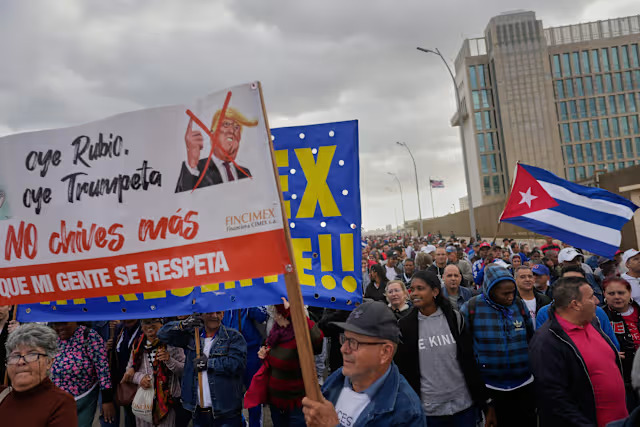
Havana, Cuba, Friday, Jan. 16, 2026. (AP Photo/Ramon Espinosa)
Trump’s policy towards Cuba is more aggressive than we have seen in recent years, but it really isn’t anything new. Since the Cuban Revolution came to power in 1959 the United States has focused on undermining the Cuban system for fear that it could be seen as an example for other countries in the Global South. A poor country achieving literacy rates on par with the most highly developed nations, and sending doctors around the world to help those most in need — all while rejecting the neoliberal order and US hegemony.
One way of undermining the Cuban system has of course been to restrict travel and business in Cuba for US citizens, but the US has also used the embargo and its economic leverage to dissuade other countries from doing business with Cuba. This has made economic conditions very difficult for Cubans, which of course the U.S. government blames on the Cuban leadership. But if the Cuban system were just destined to fail, as the US claims, why does the U.S. government feel the need to sabotage it? Why not just let it fail on its own and not have to answer for accusations of US meddling? These questions are not asked often enough.
Recent actions in Venezuela play into this as well. Until very recently, Venezuela was a major lifeline for Cuba in terms of providing oil. Now Trump is threatening tariffs against any country that dares to provide Cuba with oil. The goal here is “regime change,” and government officials are saying it openly. The expectation is that countries will not risk their relationship with the US by throwing a lifeline to Cuba.
Global power dynamics tell us that there is some truth to this, unfortunately, but Trump’s broader approach to foreign policy in his second term may be changing the way that other nations, including our closest allies, view their relationship with the U.S. The US risks being the country that is isolated in the end. These policies are not good for the people of Cuba or the US, and it’s imperative that we do everything in our power to stop it.
What follows are CCS suggestions of actions we think our supporters can take - to make our voices heard in our own communities and in Washington as well. Further, the more other countries see opposition within the U.S. to the Trump Cuban policies, the more likely they will be to show some strong opposition to Trump’s plans for Cuba.
______________________________________________________________________________________________________________________
ACTION 1:
We are linking TWO forms that you can fill out to send an automatic appeal to your specific Senator
and Representatives. By filling out the info, your message will be sent automatically on your behalf. Your
zipcode will indicate who gets your message. You’ll be able to see that message on the second page of the
form after entering your information.
ACTION 2:
Share this brief message with your network.
Dear friends and community,
I’m writing to raise awareness about the Trump administration’s renewed escalation against Cuba. The reissuance of a
National Emergency Order imposes new punitive measures aimed at cutting off the country’s access to oil. This
inhumane policy seeks to undermine the very conditions for survival in a nation that relies on imported oil for electricity,
food production, transportation, and the delivery of health care and other essential services. Everyday life is becoming
extraordinarily difficult for people across the island as they are seeing black outs often exceeding 12 hours a day.
If you’re not aware of how fundamental Venezuela has been to Cuba, know that the country was the island’s
primary supplier of oil.
The attack on Venezuela is a disturbing and unprecedented display of what Trump is capable of, constitutional or not.
Are we really going to let him continue to cripple an entire population? Please fill out the two forms below to write to your
Senator and Representatives.
Here are a few updated reading sources to learn more:
Center for Cuban Studies Statement on US-Cuba Policy
CNN: Cuba says it’s ready to talk to US, but not about regime change, as Trump ramps up pressure
In solidarity,