- Travel
-
Exhibits
- Gatos Cubanos/ Cuban Cats
- Mujeres, Cuban Women Making Cuban Art
- José Fuster
- La Portada Cubana
- Immortal Cuba: Artists Take on Their Heroes
- Seattle Poster Exhibit
- Sandra Dooley & Alejandrina Cué
- The Art of Wayacón
- Cuban Folk Art
- Cuba In Black And White
- 25 Years of Cuban Art Space
- Summer Folk Art Expo
- ¡SPRING AWAKENING FROM CUBA!
- Celebrating The Art Of Cuban Women
- Celebrating Paper, Affordable Art from Cuba
- Art of the Revolution
- Outsider Art
- Lost and Found
- En la lucha: Celebrating Cuban Women and Their Art
- Cuban Art Stash
- 100 Fires: 5 Cienfuegos Artists' Work on Paper
- Waya + Monte! Magic Realism in Cienfuegos
- Viva Cuba Viva! Poster Show
- Cultivando Sueños
- Black Lives Matter in Cuba Jan 9-March 27
- Leandro Soto: Crónicas visuales
- Cuban Canvas
-
Archive
- Global Reflection 2018: Spirit and Community
- Exhibit in the cloud: Contemporary Works on Paper
- MADE IN CUBA! MINNEAPOLIS EXHIBIT
- Cuban Posters and Photography from CCS collection
- AUTUMN SALE! Sept/Oct 2017
- SPRING ARTS AND CRAFT SALE
- Vuelo Directo/Non Stop: Alberto & Alejandro Lescay
- The Many Faces of Fidel
- Somos
- Made in Cuba!
- The US empire in Cuban graphics
- Made in Cuba/Seattle exhibit
- Entre Nos
- Looking Back
- Cuban Art Space
- Membership/Donate
- About Us
- Cuba News

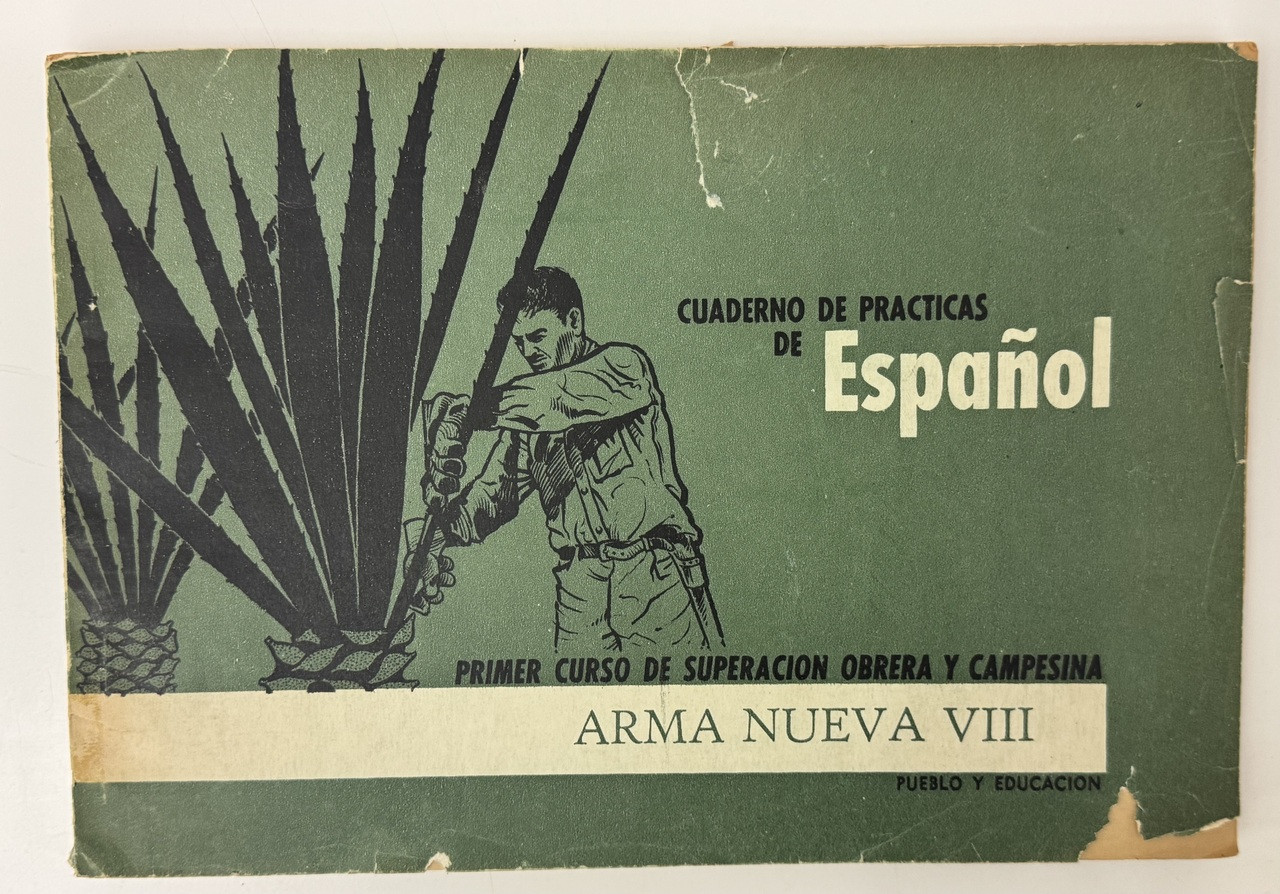
, "Cuaderno de Prácticas de Español, Arma Nueva VIII: Primer Curso de Superación Obrera y Campesina," 1968. Offset print, workbook., $65.00 (http://centerforcubanstudies.org/instituto-del-libro-pueblo-y-educacion-cover-designer-unknown-cuaderno-de-practicas-de-espanol-arma-nueva-viii-primer-curso-de-superacion-obrera-y-campesina-1968-offset-print-workbook/))
-
The cover design of this Spanish language workbook employs powerful revolutionary iconography that fuses agricultural labor with armed defense. Against a muted olive-green background, a bold line drawing depicts a campesino in work clothes carrying a rifle over his shoulder, positioned beside the dramatic silhouette of an agave or henequen plant with its sharp, radiating leaves. The worker's posture—purposeful, moving forward—embodies the revolutionary ideal of the armed producer. The typography combines bold sans-serif lettering for "Español" in cream color with condensed gothic type for the subtitle, while a horizontal cream band contains the series title "ARMA NUEVA VIII." This spare, economical design reflects the utilitarian aesthetic of Cuban educational materials during the revolutionary period, prioritizing clarity and symbolic power over decorative elaboration.
Published in 1968 during the "Año del Guerrillero Heroico" (Year of the Heroic Guerrilla)—declared in honor of Che Guevara, who had been killed in Bolivia in October 1967—this workbook represents a crucial component of Cuba's massive literacy and education campaign. The "Superación Obrera y Campesina" (Worker and Peasant Advancement) program aimed to provide continuing education to adults who had achieved basic literacy through the 1961 literacy campaign, offering them opportunities for further intellectual development while maintaining their roles as workers and agricultural laborers. The series title "Arma Nueva" (New Weapon) explicitly positions education as a revolutionary tool, equal in importance to military defense.
Published by the Instituto del Libro through its Pueblo y Educación imprint and produced by Unidad Productora No. 11 in Havana, this workbook embodies the revolutionary government's commitment to universal education as a cornerstone of social transformation. The cover's imagery of the armed campesino symbolizes the dual role of Cuban workers and peasants in the revolutionary project—simultaneously defenders of the Revolution and builders of the new socialist society. This practical pedagogical tool, with its emphasis on vocabulary building and language mastery, represents the quotidian reality of revolutionary cultural work, transforming abstract ideals of education and empowerment into concrete exercises and lessons.
-
-
Discover More at the Center for Cuban Studies